At least 36 new tech unicorns were minted in 2025 so far
With AI igniting an investor frenzy, every month, more startups obtain unicorn status. Using data from Crunchbase and PitchBook, TechCrunch…
With AI igniting an investor frenzy, every month, more startups obtain unicorn status. Using data from Crunchbase and PitchBook, TechCrunch…
The main Reuters news account, as well as the Reuters World account, have apparently been inaccessible to X users in…
Academics may be leaning on a novel strategy to influence peer review of their research papers — adding hidden prompts…

Emirates News Agency has refuted The Open Network’s claim that applicants who stake $100,000 worth of TON for three years would be eligible for 10-year golden visas.

After TON claimed a staking program would offer golden visas for holders to enter the United Arab Emirates, the country’s news agency shot down the idea of a partnership.

The following is a repost from the PayPal Developer Blog.
Building on the release of PayPal’s MCP servers, PayPal is excited to introduce the PayPal Agentic Toolkit*. This toolkit empowers developers to seamlessly integrate PayPal’s comprehensive suite of APIs — including those for managing orders, invoices, disputes, shipment tracking, transaction search and subscriptions — into various AI frameworks. With PayPal Agentic Toolkit, developers can now build sophisticated agentic workflows that handle financial operations with intelligence and efficiency.
The PayPal Agentic Toolkit is a library designed to simplify the integration of PayPal’s core commerce functionalities into AI agent workflows. By providing a structured and intuitive interface, the toolkit bridges the gap between PayPal’s powerful APIs and modern AI agent frameworks, allowing agents to perform tasks such as creating and managing orders, generating and sending invoices, and handling subscription lifecycles. It eliminates the need for developers to manually integrate with API calls and data formatting by offering pre-built tools and abstractions to streamline these interactions.
The integration of PayPal APIs with AI frameworks through the Agentic Toolkit enables developers to empower businesses with their own agents, facilitating seamless connections to PayPal services for process workflows and task generation for use cases. These include:
Go to our public GitHub repo to try out all the use cases offered by PayPal toolkit, refer to the details for installation and usage here.
*Disclaimer: PayPal Agentic Toolkit provides access to AI-generated content that may be inaccurate or incomplete. Users are responsible for independently verifying any information before relying on it. PayPal makes no guarantees regarding output accuracy and is not liable for any decisions, actions, or consequences resulting from its use.
PayPal Releases Agentic Toolkit to Accelerate Commerce was originally published in The PayPal Technology Blog on Medium, where people are continuing the conversation by highlighting and responding to this story.

The following is a repost from the PayPal Developer Blog by Prakhar Mehrotra, SVP of Artificial Intelligence, PayPal
At PayPal, we strive to make it easier for developers to access our services. Today, we are taking the first step to allow developers to embrace the new paradigm of agentic commerce by adopting the Model Context Protocol (MCP) and placing our services on an MCP server. This puts the power of generative AI at our merchants’ fingertips.
MCP is a standard put forward by Anthropic that is being adopted by the world’s leading AI companies to help standardize the way agents access data sources or third-party services, thereby enabling seamless integration–something that is paramount in AI-native, multi-agent systems. Starting today, developers can interact with PayPal’s official MCP server to begin enabling next-generation, AI-driven capabilities for merchants. This includes remote MCP servers available with auth integration on the cloud. With remote MCP support, users can seamlessly continue their tasks across devices with simple logins after the authentication process.
The availability of PayPal’s MCP server will enable a range of conversational AI capabilities for merchants, which we will roll out in the coming months. To illustrate the power of this new technology, we’re starting with PayPal Invoice feature, which is available today to eligible PayPal merchants.
Developers can now enable merchants who wish to utilize their preferred AI tools — including LLMs — to automatically generate invoices and shareable invoice links to send to their clients within their MCP host. This eliminates the need for merchants to visit the PayPal website or integrate using PayPal APIs for manual invoice creation, making the process of creating an invoice for a customer much faster, more intuitive, and easier to integrate into existing MCP clients.
Let’s say a PayPal merchant needs to create an invoice for a customer. Instead of creating one manually, they may decide to use an AI system that is integrated with PayPal’s MCP endpoint to create an invoice conversationally. The merchant simply should prompt the AI system with plain language, “Create a PayPal invoice link for painting a house with a cost of $450. Add 8% tax and apply 5% discount. Make sure it expires in 10 days.” With PayPal’s MCP, it will create an invoice based on this prompt, thanks to the power of AI.*
There are two ways of connecting to PayPal’s MCP server:
Visit https://mcp.paypal.com to get started, which includes our MCP developer toolkit on GitHub, to start setting up your local PayPal MCP server or connect to the remote MCP server.
With the introduction of the MCP, PayPal is setting the foundation upon which we can build a more intelligent and responsive digital commerce ecosystem. MCP represents our commitment to continuous improvement and innovation, ensuring our developers and merchants are well-equipped to meet the evolving demands of the digital marketplace. And we’re just getting started. We’ll share more soon as we add additional products.
*Disclaimer: PayPal’s MCP server provides access to AI-generated content that may be inaccurate or incomplete. Users are responsible for independently verifying any information before relying on it. PayPal makes no guarantees regarding output accuracy and is not liable for any decisions, actions, or consequences resulting from its use.
PayPal Begins Rollout of MCP Servers to Accelerate Agentic Commerce was originally published in The PayPal Technology Blog on Medium, where people are continuing the conversation by highlighting and responding to this story.

In today’s competitive digital landscape, understanding user interactions with your products is essential for driving revenue and building lasting customer relationships. At PayPal, our Data Science teams use causal inference to evaluate the impact of key customer actions, such as adopting a new product or adding a credit card to their wallet, on engagement (measured by Transactions per Account, or TPA), revenue, and margin to help make data-driven strategic decisions.
The direct profit from a product adoption or a user action on the app could be $0 if viewed in isolation. However, that does not necessarily mean that these events are not driving engagement and monetization across the PayPal ecosystem; they can change the user engagement with other PayPal products in such a way that the user starts generating more profit.
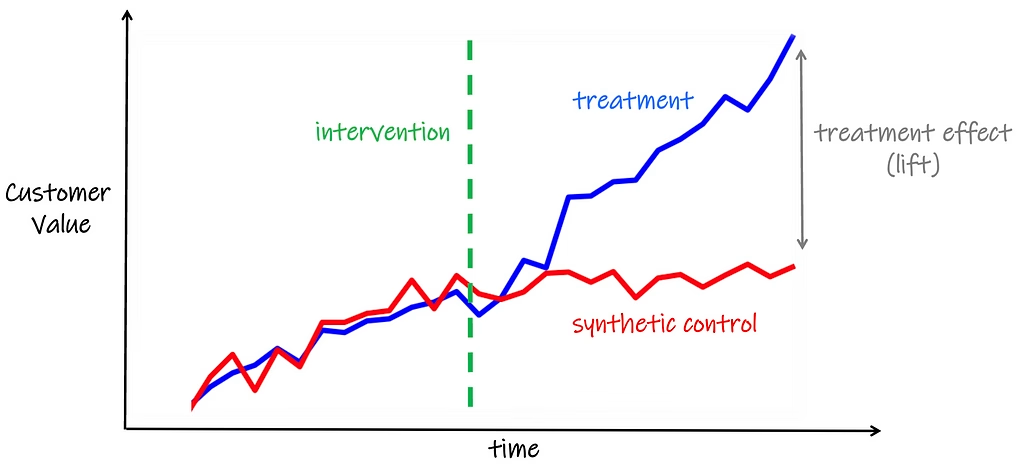
To measure the overall impact of user actions or product adoption, we introduced Delta CV (delta in Customer Value), and we defined it as a customer’s incremental profit margin in the first year after adoption of a new product or completing an action. For example, if the average Delta CV for adoption of Crypto is $20, we expect customers who adopt Crypto for the first time to bring an additional $20 in margin on average in the next 12 months after the adoption. We define Delta Revenue (or TPA) in the same manner except we calculate the incremental lift in revenue (or TPA) instead of profit margin.
The concept of Delta CV is very different from customer life-time value (CLV) which estimates the total profit generated by a customer over the course of their relationship with PayPal. Delta CV gives us a wholistic view on how new adoptions affect the engagement and value of an existing PayPal user.
Adoption of a new product or completing an action can increase the customer’s value in a few ways:
Today we estimate Delta CV for 40+ products (or actions) in multiple regions. Having Delta CV for different products helps us in a variety of areas such as strategic decision making, calculating the return on investment (ROI) of campaigns, opportunity sizing for new campaign efforts, in-app product ranking and placement, making trade-off between resource allocations, making ramp decisions on product launches, and so on.
We measure Delta CV using causal inference and synthetic control. For each product, our treatment group are the adopters of the product for the first time in each quarter. To create a synthetic control group, we focus on users who never adopted the product of interest. Then we find matches for the treatment users inside the control group based on a set of transactional features calculated over 12month pre-adoption. Since we are building a synthetic control and our target variable is CV, we should always match on CV in pre-period. The remaining of our matching features are important covariates of CV. They capture user characteristics and are our best predictors of users’ CV response to external and internal changes.

The synthetic control group acts as a counterfactual, meaning that we assume in the absence of an intervention, control and treatment group would change similarly over time. Therefore, if we introduce a change to the treatment group but not to the control group, the difference in the profit margin of the two groups measures the impact of the intervention.
We select the synthetic control group by matching on our group of features using KNN (K nearest neighbors) algorithm. Every user in treatment will have a synthetic control that is the average of up to 10 users from control. We define a threshold for the Euclidean distance between the treatment and control units, and we remove the matches that exceed this threshold to ensure a high quality of matching. The validity of synthetic control group selection can be checked by a bias analysis.

PayPal products are rapidly evolving to provide the best value and experience to customers. While checkout was PayPal’s first product, we now offer an extensive variety of financial products including peer-to-peer payments, debit card, credit card, rewarding shopping experiences with cashback, and much more, all within the PayPal App. Delta CV has been an integral part of strategic decision making in PayPal. Adding new products to the scope of Delta CV, as well as continuously adjusting the matching methodology, is an ongoing effort. Reducing the estimation biases by improving the selection of matching features is another area for improvement.
Estimating Incremental Lift in Customer Value (Delta CV) using Synthetic Control was originally published in The PayPal Technology Blog on Medium, where people are continuing the conversation by highlighting and responding to this story.