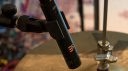
If you’re getting into recording instruments at home, clarity is going to be one of your main concerns. For this purpose, we’ve selected some of the best small-diaphragm mics to get you started.
Key Facts about Small-Diaphragm Mics:
The design of small-diaphragm mics gives them a precise, fast transient response character, which is perfect for capturing instruments such as acoustic guitars and percussion, preserving the natural clarity and attack.
Recording engineers use small-diaphragm condensers in stereo mic configurations, with techniques like AB spaced pair, XY, and ORTF, because the shape of the off-axis response patterns produces a realistic room sound with accurate stereo imaging.
When compared to large-diaphragm condensers, small-diaphragm mics offer flatter frequency response curves and a more neutral overall sound, which makes them well-suited for classical and jazz recordings.
Because of their compact design, small-diaphragm mics are useful in tight spaces, which allows flexible placement for recording choirs, orchestras, or use as drum overheads.
Often sold as a matched pair, most small-diaphragm mics come with cardioid capsules, but some manufacturers either include omnidirectional capsules or provide the option to buy them as an add-on.
In this Article:Key Facts about Small-Diaphragm Mics:Getting Started with the Best Small-Diaphragm Mics?Small-Diaphragm Mics: Behringer C-2Small-Diaphragm Mics: RODESmall-Diaphragm Mics: Lewitt LCT 040Small-Diaphragm Mics: sE Electronics SE7Small-Diaphragm Mics: Audio-TechnicaSmall-Diaphragm Mics: ShureSmall-Diaphragm Mics: Neumann KM 184The Best Small Diaphragm Mics: Schoeps Colette MK 5FAQsMore about the Best Small Diaphragm Mics:
Also commonly referred to as ‘pencil mics’, small-diaphragm condenser mics are some of the most versatile recording tools available. Their slim, compact design allows them to be used in a range of stereo and mid-side configurations.
In addition, their wide frequency response makes them suitable for almost any sound source. From piano to vocal groups, percussion, and acoustic guitars, these mics can capture realistic performances without too much trouble.
Getting Started with the Best Small-Diaphragm Mics?
Besides phantom power, cables, and mic stands, the beauty is that you really don’t need much to use these mics. They don’t require much gain at all, so you’ll be able to get decent results going straight into your interface in most cases.
Although using a dedicated preamp can provide you with more precise gain control and a lower noise floor, it’s not essential when you’re getting started.
Let’s take a look at some basic cardioid condensers that can become new creative tools in your home studio.
Small-Diaphragm Mics: Behringer C-2
If you’re getting into recording instruments at home, the C-2 is a great way to start. It’s an entry-level FET condenser, with a simple design and straightforward operation. Its cardioid pickup pattern makes it suitable for most recording applications.
Behringer C-2 · Source: Behringer
Whether you’re looking to record piano, brass, woodwinds, percussion, or acoustic guitar, the C-2 has all the necessary accessories to get you started. Inside the carry case, you get windshields, mic clips, and a stereo spacer.
With a single switch, you can access the 120 Hz low-cut filter and -10dB pad. Overall, the C-2 provides value at an unbeatable price and adds a useful tool set to your home studio.
More from Behringer
Affiliate Links
Behringer C-2 Stereoset
Customer rating: (1334)
$41.00 / £35.00 / 42.00€ at
Behringer C-2 Dark Edition Stereoset
Customer rating: (16)
$47.00 / £41.00 / 48.00€ at
Small-Diaphragm Mics: RODE
The popular Australian mic manufacturer offers a wide selection of small-diaphragm condensers for different applications. The versatile M3, with its cardioid end-address design, can be powered with a 9V battery, while the compact M5 is available in a matched pair at an affordable price.
RODE M5 · Source: Rode
For improved clarity, the NT5 uses a true condenser capsule, which is interchangeable, compared to the electret design of the M Series, and is available as a matched pair or separately. Meanwhile, the NT55 uses the same capsule family, but adds switches for high-pass filter (75 Hz / 150 Hz) and pad (-10 dB / -20 dB).
For multi-purpose applications, the rugged construction and larger diaphragm of the NT3 make it more stage-friendly, with optional battery operation. For more specialized tasks, RODE also offers the stereo NT4 and ambisonic NT-SF1, while the premium TF-5 pair tops off the range with its custom Tony Faulkner capsules. Get it at Thomann.*
More from RODE
Affiliate Links
Rode M3 Bundle
Customer rating: (96)
$102.00 / £93.00 / 105.00€ at
Rode M5 MP
Customer rating: (559)
$149.00 / £135.00 / 156.00€ at
Rode NT5 MP
Customer rating: (1058)
$299.00 / £269.00 / 310.00€ at
Rode NT55 MP
Customer rating: (41)
$599.00 / £539.00 / 615.00€ at
Rode NT3
Customer rating: (88)
$222.00 / £199.00 / 229.00€ at
Rode TF-5
Customer rating: (5)
$1,359.00 / £1,222.00 / 1,399.00€ at
Small-Diaphragm Mics: Lewitt LCT 040
The LCT 040 is the entry-level small-diaphragm condenser from Austrian mic manufacturer Lewitt. The extremely compact and lightweight design makes it easy to transport and convenient for close proximity XY or ORTF configurations.
Lewitt LCT 040 · Source: Lewitt
Besides the carry bag, you also get mic clips and a set of windshields, which can be useful for reducing harsh reflectivity in the less-than-ideal recording environments you might find at home.
Lewitt has a great reputation with mics, so the LCT 040 is a sure buy as far as sound quality goes.
More from Lewitt
Affiliate Links
Lewitt LCT 040 MATCH stereo pair
Customer rating: (237)
$185.00 / £166.00 / 189.00€ at
Small-Diaphragm Mics: sE Electronics SE7
Also well-known for designing microphones that are both good quality and affordable, it’s no surprise to find the SE7 on this list. The rugged construction means they’re built to last, so you don’t need to worry about using them every day if you have to.
sE Electronics SE7 · Source: sE Electronics
Furthermore, the SE7 can handle high-SPL sources, and with the addition of the -20 dB pad switch you can happily use these mics as drum overheads. In addition, the set comes with mic clips and windshields to get you started right away.
With its overall quality and utility, the SE7 is certainly one of the best options in this price range.
More from sE Electronics
Affiliate Links
SE Electronics SE7 Stereo-Set
Customer rating: (54)
$199.00 / £175.00 / 208.00€ at
Small-Diaphragm Mics: Audio-Technica
The Japanese manufacturer Audio-Technica has an extensive range of small-diaphragm mics with price tags between $100-$500. Starting with the AT2031, you can get an end-address design with a cardioid pickup pattern and a 150 Hz high-pass filter switch with a wind shield and a mic clip for just over $100 a piece.
Audio-Technica AT2031 · Source: Audio-Technica
Meanwhile, the ultra-compact PRO37 is better suited for sound reinforcement, with a more aggressive frequency response curve that rolls off at 15 kHz. For multi-purpose applications, the AT8033 can be powered by an AA battery, and it can be used as a handheld interview mic with an 80 Hz low cut filter to avoid handling noise.
For overhead applications, the cardioid ATM450 uses a side-address design, while the AT40 Series provides a range of options with cardioid and omnidirectional capsules, including the AT4041, AT4021, and AT4022, as well as the modular AT4051B and AT4053B that have interchangeable capsules and a -10 dB pad switch for high-SPL sound sources. Get it at Thomann.*
More from Audio-Technica
Affiliate Links
Audio-Technica AT 2031
Customer rating: (101)
$105.00 / £95.00 / 109.00€ at
Audio-Technica Pro 37
Customer rating: (14)
$169.00 / £153.00 / 174.00€ at
Audio-Technica AT 8033
Customer rating: (11)
$203.00 / £181.00 / 209.00€ at
Audio-Technica ATM 450
Customer rating: (62)
$252.00 / £225.00 / 259.00€ at
Audio-Technica AT4041
Customer rating: (15)
$289.00 / £259.00 / 299.00€ at
Audio-Technica AT 4021
Customer rating: (12)
$325.00 / £289.00 / 333.00€ at
Audio-Technica AT 4022
Customer rating: (11)
$369.00 / £329.00 / 379.00€ at
Audio-Technica AT 4053B
Customer rating: (27)
$485.00 / £439.00 / 499.00€ at
Audio-Technica AT 4051 B
Customer rating: (19)
$487.00 / £435.00 / 499.00€ at
Small-Diaphragm Mics: Shure
The Shure small-diaphragm condenser range starts off slightly pricier, with the SM137, which is essentially a more modern version of the KSM109 with a characteristically flat low-end response and a slight presence boost. In contrast, the trusted industry standard SM81 is ultra-clean and clinical, but it offers slightly lower headroom for loud sound sources.
Shure SM81 · Source: Shure
The more compact cardioid KSM137 expands the scope of applications with higher output and headroom, making it also useful for sound reinforcement. Meanwhile, the KSM141 adds the flexibility of switchable polar patterns (cardioid/omni), and both KSM models are available in matched pairs or separately.
Overall, even the older models in the Shure range are extremely competitive, which is why options like the SM81 are still the preferred choice of professionals after all these years. When making your choice, be sure to take into account the type of applications you require and match this with the frequency response, headroom, and polar pattern of the mic. Get it at Thomann.*
More from Shure
Affiliate Links
Shure SM137-LC
Customer rating: (24)
$239.00 / £215.00 / 245.00€ at
Shure SM81
Customer rating: (115)
$411.00 / £369.00 / 425.00€ at
Shure KSM 137 Stereoset
Customer rating: (6)
$875.00 / £789.00 / 898.00€ at
Shure KSM 141 ST Stereoset
Customer rating: (24)
$1,019.00 / £919.00 / 1,045.00€ at
Small-Diaphragm Mics: Neumann KM 184
Neumann KM 184 and its omnidirectional counterpart, the KM 183, come from a particularly prestigious line of small diaphragm mics. The KM 80 series was introduced in 1966, and its FET circuitry marked Neumann’s move into solid-state designs. Another important fact is that the KM 83 and KM 84 were the first mics to use phantom power, a standard still widely used today.
Neumann KM 184 · Source: Neumann
These small diaphragm mics have an unmistakably natural sound, which makes them ideal for grand piano recordings. However, you can get great results on virtually any acoustic instrument, provided you’re aiming for a true representation of the sound. This includes instruments like percussion and acoustic guitars, as well as any traditional exotic instruments you can think of.
The KM series stereo pairs come in their own specially designed wooden box with a molded foam insert for all the components, including the microphones, mic clips, and windshields. While the KM 180 series is priced out of home studio territory, they are certainly essential for pro studios with treated live rooms for capturing natural ambience. Get it at Thomann.*
Learn about the History of Neumann
Affiliate Links
Neumann KM184 mt Stereo Set
Customer rating: (303)
$1,490.00 / £1,333.00 / 1,529.00€ at
Neumann KM184 Stereo Set
Customer rating: (69)
$1,490.00 / £1,333.00 / 1,529.00€ at
The Best Small Diaphragm Mics: Schoeps Colette MK 5
When you absolutely must have the best mics for pristine orchestral recordings, Schoeps are trusted by the top recording facilities and sound stages. These incredibly transparent microphones are modular by design, so the CMC 6 microphone amplifiers are compatible with a range of different Schoeps capsules.
Schoeps Colette MK 5 · Source: Schoeps Microphones
However, this stereo set includes the MK 5 capsules are equipped with a switch to toggle between cardioid and omnidirectional pickup patterns, so you’ll only be shopping for new capsules if you’re doing something incredibly niche. The CMC 6 comes from a line of mics first introduced in 1973, and the prototype was built in 1990.
Since then, the CMC 6 has been through nine generations of updates, so it’s safe to say that you are getting the best in microphone technology for the modern recording era. Microphones of the Schoeps standard are a considerable financial investment, but they immediately set one studio apart from the rest, like any tried and tested piece of high-end gear. Get it at Thomann.*
Read about the Schoeps Colette Modular Mic Series
Affiliate Links
Schoeps Stereo-Set MK 5
Customer rating: (9)
$3,690.00 / £3,269.00 / 3,779.00€ at
FAQs
1. What are small-diaphragm microphones best used for?
Small-diaphragm mics are used most often for the recording of acoustic instruments. Because of their accurate transient reproduction, they capture the finer details of orchestras, pianos, percussion instruments, and can be used as drum overheads.
2. Are small-diaphragm condenser mics good for vocals?
Yes, small-diaphragm mics can capture vocals well, especially vocal ensembles in situations where realism is the goal. Meanwhile, large-diaphragm condensers are generally preferred for vocal recording in contemporary music styles for close-up detail.
3. What is the difference between small-diaphragm and large-diaphragm microphones?
Small-diaphragm condensers generally provide a more natural and consistent frequency response curve, while large-diaphragm mics often enhance and colour the spectrum to favour the vocal range, adding fullness and roundness.
4. Why are small-diaphragm mics popular for stereo recording?
Due to the accuracy of the stereo imaging and their consistent phase, small-diaphragm condensers are widely used in stereo mic techniques to capture the realism of a performance in a space.
5. Can small-diaphragm microphones be used for live sound?
Yes, small-diaphragm condensers are often used for sound reinforcement applications. Their compact size and clarity make them useful for acoustic instruments, choirs, cymbals, and stage ambience.
More about the Best Small Diaphragm Mics:
All about condenser microphones
More about Home Recording
Thomann’s guide to small-diaphragm mics
Videos:
*Note: This article contains promotional links that help us fund our site. Don’t worry: the price for you always stays the same! We will receive a small commission if you buy something through these links. We appreciate your support!
The post Small-Diaphragm Mics for Capturing Realism appeared first on gearnews.com.