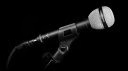
These Shure SM58 Alternatives will help you out of tight spots where the 58 doesn’t suit the application or vocalist you’re working with.
Key Facts about SM58 Alternatives:
The SM58 is a popular handheld dynamic mic mostly used for live vocals with a cardioid pickup pattern, which isolates the singer from any unwanted noise on the stage.
One of the main benefits of SM58 Alternatives is different polar patterns, so options like the AKG D5 are supercardioid, while many of the Audix OM series mics are hypercardioid. This gives engineers options for reducing spill and feedback on stage.
SM58 Alternatives also offer different frequency response curves that may be better suited to certain voices or vocal styles. As a result, some mics will achieve better results for solo acts or duos, while others cut through even dense mixes.
The SM58 is known for its outstanding durability, so if you are expecting to use an alternative mic as frequently in a live sound environment, ensure it’s built to withstand the same demanding conditions.
In this Article:Key Facts about SM58 Alternatives:SM58 AlternativesSM58 Alternatives: Behringer ULTRAVOICE XM8500SM58 Alternatives: AKG D5SM58 Alternatives: Sontronics SoloSM58 Alternatives: AUDIX OM5SM58 Alternatives: sE Electronics V7SM58 Alternatives: Shure BETA 58ASM58 Alternatives: Mojave MA-DSM58 Alternatives: Austrian Audio OD505FAQMore about SM58 Alternatives:
Introduced in the mid-1960s, the Shure SM58 quickly became as synonymous with live music as a microphone can be. With its legendary Unidyne III transducer, engineer Ernie Seeler aimed for the microphone to have a uniform polar response over the entire frequency range. This means that the SM58’s cardioid pickup pattern is almost identical throughout the lows, midrange, and high frequencies.
Read more about the revolutionary design of the SM58
Affiliate Links
Shure SM58 LC
Customer rating: (5804)
$109.00 / £99.00 / 115.00€ at
Shure SM58
$109 at
SM58 Alternatives
If you’re an engineer or vocalist and you haven’t yet used an SM58 and compared it to other mics, we highly recommend that you do this. We have carefully put together a list of viable alternatives to this industry-standard stage mic.
However, it’s important to remember that similar dynamic mics would not be here without the resounding success of the 58. That being said, let’s take a look at some options that could help you in situations where the vocal performer’s voice isn’t quite matching the SM58, or it doesn’t suit a particular stage environment.
SM58 Alternatives: Behringer ULTRAVOICE XM8500
The Behringer XM8500 is a decent stage mic you can get for just 20 bucks. This is ideal for stocking the mic locker of a small venue or getting a microphone to rehearse and record with at home. The XM8500 has a very similar frequency response to the SM58, with presence boost between 3 and 6 kHz and a high-frequency dip after 7 kHz.
Behringer ULTRAVOICE XM8500 · Source: Behringer
This contributes to the overall intelligibility and clarity of speech and vocals, as well as the mic’s ability to cut through dense mixes. Another key aspect that users love about the XM8500 is its excellent off-axis rejection. This means that even in noisy stage environments or untreated rooms, the chance of feedback is drastically reduced, especially if you get your gain structure and mic technique right.
In addition, the XM8500 has an internal shockmount system that decreases handling noise and vibration. Its impedance rating is the same as the SM58 (150 ohms), which means a decent mic preamp will immediately produce better results. Overall, when one combines the build quality, sound, and price, the XM8500 more than earns its place on this list.
Get it at Thomann*
Get it at Sweetwater*
More from Behringer
Affiliate Links
Behringer XM8500
Customer rating: (1707)
$18.90 / £16.80 / 19.90€ at
Behringer XM8500
$19.90 at
SM58 Alternatives: AKG D5
When you need a mic for a solo performer (vocal + guitar) in a small venue, the AKG D5 is the perfect choice. It might not have the same presence range as the SM58 for cutting through the dense mixes of high-SPL rock concerts, but the D5 has a warmer and more rounded sound that needs less EQ to make it really shine on vocals.
AKG D5 · Source: AKG
The 2 kHz bump is followed immediately by a dip at 3 kHz, while the 6.5 kHz dip between the 5 – 8 kHz boost tames any resonance in this area. Overall, this gives the D5 a natural sound that portrays the subtlety of a vocal performance required in more intimate settings, which also makes it great for recording vocals at home.
Its supercardioid pickup pattern makes the D5 ideal for stage use, with an integrated dual shock mount that reduces any mechanical noise or rumbling. In addition, it’s also available in a version with a noiseless switch, the D5 S, for those who require the ability to deactivate the mic quickly and easily from the stage.
Get it at Thomann*
Get it at Sweetwater*
More from AKG
Affiliate Links
AKG D5
Customer rating: (467)
$85.00 / £72.00 / 85.00€ at
AKG D5
$139 at
SM58 Alternatives: Sontronics Solo
The Sontronics Solo is a premium handheld dynamic mic, hand-built in the UK with the aim of delivering an alternative to the SM58 with a slightly more polished sound that requires less EQ or processing. With its supercardioid pickup pattern, the Solo offers excellent off-axis rejection and feedback control for loud stage environments.
Sontronics Solo · Source: Sontronics
While it’s slightly heavier than the SM58, the Solo is just as durable with its precision-engineered aluminum body and black anodized finish, while its flat top grille offers more stability when held. The most important feature of the Solo is its punch and presence, which it gets from the high-output capsule.
This gives the Solo a sensitivity rating of 5.5mV/Pa, so it will deliver excellent results when connected to the preamps of the average live mixing console, and it can handle high-SPL sources of over 140 dB. The Solo ships with its own microphone clip and thread adapter, as well as a protective storage pouch.
Get it at Thomann*
More from Sontronics
Affiliate Links
Sontronics Solo
Customer rating: (56)
$104.00 / £95.00 / 109.00€ at
SM58 Alternatives: AUDIX OM5
The OM5 is a viable American-made SM58 alternative with a particularly feedback-resistant design. This is due to its hypercardioid pickup pattern that affords such excellent off-axis rejection. With a healthy boost in the midrange, the OM5 offers great vocal presence and clarity and the low-end dip will help reduce the resultant bass increase from the proximity effect.
AUDIX OM5 · Source: Audix
In addition, the OM5 can handle extremely high SPL levels of over 144 dB, so it’s perfect for rock and metal vocalists. Also, it’s a great choice for touring, with its durable die-cast zinc alloy construction that includes a rugged steel mesh grille. Sonically, the OM5 delivers vocals cleanly in a way that translates regardless of venue size or music style.
For smaller-scale acts that are using different mic preamps at every venue, the OM5 shines with its high output level. This means you’ll be able to capture your vocal performance with consistent quality for all your tour dates. The OM5 also includes a protective carrying pouch, a mic clip, and a thread adapter.
Get it at Thomann*
Get it at Sweetwater*
More from AUDIX
Affiliate Links
Audix OM5
Customer rating: (55)
$152.00 / £138.00 / 159.00€ at
AUDIX OM5
$179 at
SM58 Alternatives: sE Electronics V7
Although it doesn’t have quite the same heritage as the SM58, the sE V7 is certainly an industry sleeper, loved by those in the know. The supercardioid V7 uses a neodymium magnet in its design, which extends the frequency range, and the response curve is smooth for the most part, giving the mic its natural sound.
sE Electronics V7 · Source: sE Electronics
This comes from a 3.5 kHz bump, a gradual 6 kHz dip, and an 11 kHz boost that gives the V7 its excellent vocal clarity and detail. Meanwhile, the integrated shock mount system reduces handling noise, and the pickup pattern provides good off-axis rejection for feedback reduction in high-SPL situations.
The V7 is available in a range of different colours and options, including a model with a switch and one with a push-to-talk button for talkback applications, which is great for FOH engineers. Also included with the V7 is a carrying pouch, mic clip, thread adapter, and a spare windshield.
Get it at Thomann*
Get it at Sweetwater*
More from sE Electronics
Affiliate Links
SE Electronics V7
Customer rating: (175)
$95.00 / £81.00 / 98.00€ at
sE Electronics V7
$105 at
SM58 Alternatives: Shure BETA 58A
Is the BETA better? Well, Shure’s other great handheld dynamic mic, the BETA 58A, is different in several ways. Firstly, while the SM58 has a cardioid pickup pattern, the BETA 58A is supercardioid, which means the off-axis rejection is stronger, so you can easily use it in high-SPL environments with stage monitors.
Shure BETA 58A · Source: Shure
The other main difference between these mics is the frequency response curve. The BETA’s response extends further into the lows and highs than the 58, and it’s 4 dB more sensitive, which makes it suitable for different types of voices or stage applications. With its special pneumatic internal shock mount system, the BETA is slightly quieter when it comes to handling noise.
You’ve probably heard the BETA 58A used for vocal recording on famous albums in the 1990s, such as Achtung Baby (U2) and The Downward Spiral (NIN). Overall, although it’s slightly more expensive, the hardened grille makes the BETA a rugged and worthy addition to your mic locker.
Get it at Thomann*
Get it at Sweetwater*
More from Shure
Affiliate Links
Shure Beta 58 A
Customer rating: (2603)
$177.00 / £159.00 / 185.00€ at
Shure BETA 58A
$179 at
SM58 Alternatives: Mojave MA-D
When a renowned microphone designer like David Royer decides to create a dynamic mic for live applications, there is no need for it to sound like other mics. In fact, his approach was to look at where historic dynamic mic designs generally fell short, and see where the MA-D could fit into this space with its own sonic identity.
Mojave MA-D · Source: Mojave Audio
This was achieved by using a lighter voice coil made with thinner wire and a thinner plastic membrane for the diaphragm, giving the MA-D a faster transient response and a detailed, hi-fi sound that you wouldn’t normally expect from a handheld dynamic mic. Also, the frequency response curve between 100 Hz and 8 kHz is characteristically smooth, with a slight peak around 10 kHz.
This contour is designed to flatter the sound of any vocalist and ensure that they sound great on any PA system, regardless of the venue. It also creates a little less work for the engineer, because the design of the MA-D has considered the different aspects of live stage performance to ensure that this is a tool you’ll enjoy using.
Get it at Thomann*
Get it at Sweetwater*
More from Mojave
Affiliate Links
Mojave MA-D
Customer rating: (2)
$171.00 / £148.00 / 179.00€ at
Mojave MA-D
$199 at
SM58 Alternatives: Austrian Audio OD505
The OD505 from Austrian Audio is an active dynamic stage microphone designed to combine the durability and isolation of a dynamic mic with the clarity and detail you’d expect from a condenser. With its integrated active amplifier, the OD505 requires 48V phantom power, but this ensures consistent signal transmission and gives it a higher sensitivity rating (4.4 mV/Pa) compared to the SM58.
OD505 · Source: Austrian Audio
Its dual-capsule design uses the active forward-facing capsule for capturing sound with its supercardioid pattern, while the passive secondary capsule is polarity-rotated in order to cancel out unwanted low frequencies from handling noise and stage rumble. Using the open acoustics design approach, Austrian Audio has reduced internal reflections and coloration for the most natural sound possible.
Inside the grille cage, the OD505 also features a 3D Pop Noise Diffuser, which is designed to considerably reduce plosives without affecting clarity. While the OD505 is a high-sensitivity mic (for a dynamic), its 275 ohms impedance rating means it will perform best with a professional-grade mic preamp.
Get it at Thomann*
Get it at Sweetwater*
More from Austrian Audio
Affiliate Links
Austrian Audio OD505
Customer rating: (22)
$215.00 / £198.00 / 227.00€ at
Austrian Audio OD505
$329 at
FAQ
1. What is the Shure SM58 primarily used for?
The Shure SM58 is a handheld dynamic microphone widely used for live vocal performance, with excellent durability and a frequency response curve that allows it to cut through dense mixes.
2. Do SM58 alternatives sound different from an SM58?
Yes. Because of the different pickup patterns, frequency response curves, and voicing, each SM58 alternative can have a slightly different sound character, some emphasizing vocal clarity and others adding low-end warmth.
3. Why is the SM58 so popular for live vocals?
With its cardioid pickup pattern, the SM58 rejects unwanted sound in off-axis zones, which can improve gain before feedback. It’s also voiced for vocal intelligibility on large-scale sound systems, even with dense mixes.
4. Do SM58 Alternatives benefit from professional mic preamps?
Absolutely. Mic preamps with precise discrete gain controls can get the best performance from dynamic mics and allow you to optimize the gain for a specific performer or venue.
5. Can SM58 Alternatives be used for studio recording?
Yes. While these handheld dynamic mics are mostly used for live vocals, they are also suitable for studio recording and can be used in conjunction with a pop filter to further reduce sibilance and plosives.
More about SM58 Alternatives:
The Best Live Vocal Mics
Thomann’s Guide to Stage Mics*
*Note: This article contains affiliate links that help us fund our site. Don’t worry: the price for you always stays the same! If you buy something through these links, we will receive a small commission. Thank you for your support!
The post Shure SM58 Alternatives: Smart Options for Live Vocals appeared first on gearnews.com.