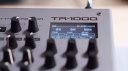
Roland’s TR-1000 gets even better with update version 1.20, bringing new MFX, locked-in LFOs, 808 and 909 ACB bass sound generators, and more.
Roland TR-1000 Rhythm CreatorRoland TR-1000 Update 1.20New Editor Lets You Control the TR-1000 From Your DAWNew EditorRoland TR-1000 ReviewRoland TR-1000: The HighlightsRoland TR-1000: The Rhythm TerminatorA Cultural IconGenerate the SoundAnalog Is BackAdvanced ACB and FMSP Sampling Comes to TRYou Better Work: Workflow on the TR-1000Out and About: So Many OutputsRoland TR-1000: In ConclusionProsConsPricing and AvailabilityMore Information
Roland TR-1000 Update 1.20
Polyend dropped the Drums so Roland said “hold my sake” and today announced firmware update 1.20 for the TR-1000. This new update brings some pretty cool new features to the drum machine, including lo-fi MFX and two new ACB bass sound generators.
Roland TR-1000 · Source: Roland
The update features:
New MFX in the form of SP-303 and SP-404 Vinyl Sims, Cassette Sim, and DJFX Delay
Locked-in LFOs, including track and full kit LFOs, as well as sample & hold
ACB sound generators for 808 and 909 bass tones, which you can use as kicks or basslines
Workflow improvements like independent layer panning, updated gain staging, and expanded MIDI control
Both Roland and Polyend are at Superbooth. I’d love to see a head-to-head soundclash between the two rhythm machines.
Head to Roland’s website to download the update.
The TR-1000 is available from Thomann*.
Affiliate Links
Roland TR-1000
Customer rating: (9)
$2,659.00 / £2,375.00 / 2,699.00€ at
New Editor Lets You Control the TR-1000 From Your DAW
[10 April 2026] Momo Müller’s new third-party editor for the Roland TR-1000 puts the drum machine in your DAW as a plugin.
New Editor
Roland’s TR-1000 Rhythm Creator drum machine continues to impress. And while there’s already an official editor application available through Roland, it’s standalone-only, meaning if you want to automate parameters in your DAW, you’re out of luck. Enter Momo Müller.
If you’re a regular reader of Gearnews.com, you’ll have seen the name Momo Müller before. The developer creates third-party controller apps for hardware instruments and releases them in both desktop and plugin versions. Now he’s turned his talents towards making an editor for the TR-1000.
Called Roland TR-1000 Controller/Editor, the new application gives direct access to the drum machine’s sound parameters, X-Y modulation of all parameters, a Multi-Pad function to tweak up to four controllers simultaneously with your mouse, in-DAW automation, and a random function for generating new presets. You can also save editor settings as a preset in the editor or in the DAW along with the project.
The editor is available for both Mac and PC and comes as a standalone app as well as in VST2, VST3 and AU plugin formats. It costs $7 / €6.90 and is available through Momo Müller’s store.
Momo Müller Roland TR-1000 Controller/Editor product page
Roland TR-1000 Review
[1 October 2025] Roland’s TR-1000 Rhythm Creator drum machine has analog circuits along with a number of improvements over its TR-8S predecessor. But is it enough to justify the high price?
Roland TR-1000: The Highlights
Analog, ACB, FM, PCM, and sample sound sources
2048 user drum kits (128 x 16 projects)
Per-sound and master effects, including analog filter and drive
True sampling and loop slicing
64GB of internal memory with 46GB of user memory
TR-style step and live recording modes
2048 user patterns (128 x 16 projects)
8 variations and 4 fill-ins per pattern
Song mode
Individual outs, trigger CV/gate, USB MIDI, and audio
Affiliate Links
Roland TR-1000 Rhythm Creator
€2699 at
Roland TR-1000: The Rhythm Terminator
Roland TR-1000 · Source: Roland
At long last, a new Roland TR drum machine has dropped. Part of a long and glorious history of epoch-making machines, the latest is being pitched in the launch campaign as Tomorrow Returns, a nod to the series’ past as well as Roland’s goal to design the future. The TR-1000 Rhythm Creator (to use its full name) is also the direct descendant of the TR-8S, an extremely popular and live-ready rhythm machine that brought sampling to the series. The latest TR continues along this same line, boosting the sampling engine with features from the SP-404MKII as well as infusing it with analog circuitry at both the sound generation and output stages, surely the biggest selling point for an instrument with deep analog roots.
A Cultural Icon
Roland has become more than just a musical instrument manufacturer. It’s practically a cultural icon at this point, with its TR-808 and TR-909 instruments known beyond the music-making community. The SP series of phrase samplers is almost as legendary, helping birth new genres of hip-hop like lo-fi. Uniting these two cultural titans under one chassis would be no easy feat, so it makes sense that the company spent a lot of time consulting with artists like Carl Craig and Underground Resistance in Detroit, Overmono and Floating Points in London, and Kuniyuki Takahashi and Satoshi Tomiie in Japan, to get it just right.
Talking to Carl Craig and King Britt · Source: Roland
The result is a beautiful-sounding and extremely full-featured drum machine that hits all the right points, and hits hard in the sonic department too, thanks to the new analog sound engine and other aural improvements. It’s also classy as hell, with an understated metal body and none of the circus light LEDs that polarized users of the TR-8S. It’s also considerably more expensive than that drum machine. Is it worth the higher price, though?
Generate the Sound
Let’s start with the sounds themselves, as this is where the TR-1000 is much more involved than its predecessor. Unlike the TR-8S, where each sound like a kick or snare is called an Instrument, there’s a deeper layer on the TR-1000, the Sound Generator. You can think of this like an oscillator and the Instrument itself as more of a preset. This Sound Generator can be any number of different types of sound: analog, ACB (Analog Circuit Behavior), VA waveforms, FM, or a sample. (We’ll look at these more in detail later.)
Roland TR-1000 · Source: Roland
Each Instrument in the TR-1000 also offers its own digital filter section and an amplifier, with a compressor, effects, and an LFO with three destinations above that. Additionally, four of the tracks (there are 10 total) allow you to layer two Instruments, A and B, with shared compressor, effects, and modulation. You can trigger these together or individually on their shared sequencer lane.
Moving up in the hierarchy, Instruments are organized into Kits. This level includes mixer parameters such as panning, delay, and reverb sends, sidechaining, FX (including an analog stage), and output routing.
Compared to some older Roland products, which can require a lot of head scratching to understand and confusing terminology to remember, the organization of sounds in the TR-1000 is relatively intuitive.
Next, let’s look at each type of Sound Generator in turn.
Analog Is Back
After 40-plus years, analog circuitry returns to the TR series. Was it worth the wait? Very much so. Development on the TR-1000 took four years, longer than most new instruments. A good portion of this time was spent getting the analog sound generators just right. This involved speaking with artists, auditioning their 808s and 909s, and choosing the sound variations to recreate. It may not sound like the one drum machine that you’re familiar with – devices could differ in sound across production runs as well as due to component aging over time – but it does have that unmistakable TR analog tone.
Developing the TR-1000 · Source: Roland
The engineering team wasn’t able to do every sound on the original machines, but it did deliver analog versions of kicks, snares, low and high toms, rimshots, and hand claps from both 808 and 909, plus 808 closed and open hats, cymbal, and cowbell. These 16 sounds represent a pretty good compromise for analog heads, with only a few 808 sounds like claves and congas missing (the 909 used PCM samples for its hats and cymbals).
Additionally, there’s an extremely powerful Analog FX section on the master bus. This adds a Jupiter-6-style multimode filter with low-, high-, and bandpass circuits for filtering and harmonic shaping, as well as an analog drive that crucially doesn’t lose bass weight when you crank it. Both of these sound incredible and are a huge part of the overall sound. They also help the different Sound Generator types sit together in the output mix.
Advanced ACB and FM
The ACB engine, which forms the main sound generation platforms on the TR-8 and 8S, also appears in the TR-1000, but there’s also a new advanced form of ACB, which Roland is calling circuit-bent ACB, for new sets of 808 and 909 sounds (marked with an X). These give you additional control, allowing for more extreme changes to the base sounds. Although analog will be the main draw for many, this new ACB should not be overlooked, especially if sound design is your thing.
Roland TR-1000 · Source: Roland
A late addition to the TR-8S in the form of a firmware update was FM. This is also present in the 1000, an additional way to create unique drum sounds that work especially well in electronic genres like IDM and electro.
SP Sampling Comes to TR
The big surprise for me was just how robust the sampling engine is on the TR-1000. With Takeo Shirato, the project lead on the SP-404MKII and a hip-hop producer himself, involved with the creation of the 1000, it stands to reason that the sampling engine would be more than just an 8S port.
The OLED screen made the jump from the SP-404MKII · Source: Roland
To wit, you get true sampling, with an audio in to capture audio like a proper hardware sampler. You can also import samples via USB stick, as on the 8S, but that’s pretty cumbersome. Much better is drag-and-drop import via the computer app, which also acts as an editor and patch librarian.
The app acts as an editor and preset librarian · Source: Roland
Sampling is a real joy with the 1000. It’s fast and easy to do, and you’ll have captured sounds running in your TR tracks in no time. As with the SP-404MKII, the 1000 also supports slicing, with an auto mode that separates loops into 16 equally sized chunks. I’d love to see Automark, which places slices on transients, make the transition from the SP, as adjusting markers on the TR OLED screen (also an SP port) is fiddly. This is where you’ll really appreciate the app, as it gives you a much clearer view of the waveform. Thankfully, editing is nondestructive, another request that came up during artist consultations.
Resampling is also easy enough, with multiple options including instruments and patterns available.
You Better Work: Workflow on the TR-1000
For the most part, if you have any TR experience, you’ll feel immediately at home sequencing and performing with the TR-1000, especially if you’re trading up from a TR-8S. The 1000 has inherited the same pattern arrangement, with 128 patterns and 16 projects, with each pattern offering eight variations (A to H) and a chaining function plus four fill-ins.
Roland TR-1000 · Source: Roland
Programming tracks is done either TR-style, that is, assigning notes to the 16 horizontally arranged buttons, or via Instrument Play, which lets you trigger sounds live. And yes, you can turn quantization off, meaning it’s possible to work in Dilla time if you like.
Although TR programming can feel old-fashioned in these days of complicated Elektron operating systems, Roland has given the 1000 pretty much everything a modern producer could need for sequencing, including pattern direction, per-track sequence length for polyrhythms, sub steps for ratcheting, step probability, and the ability to nudge a step’s start position forwards or backwards for wonky timing. Cycle is an interesting new feature that allows you to set how many cycles over which a sound plays, for example, a snare hitting on the second of every five cycles. There’s also per-step effects locks, overall and per-step motion recording, and more.
The Morph control lets you program macro transitions · Source: Roland
In terms of performance modes, the TR-1000 isn’t as live-focused as the 8S, if just because it’s so much bigger and heavier. Roland created this for studio use, first and foremost. However, if you’re comfortable bringing something this expensive on the road, it does offer a cool new feature for getting the crowd excited, the Morph crossfader. This acts like a macro and allows you to design transition effects for drops and other changeovers by assigning effects and instrument parameters to the fader and changing them all simultaneously, like automation on a DAW.
Out and About: So Many Outputs
The original TR machines are beloved for many reasons, and a big one is individual outs. A drum machine with just a single output is a frustrating thing. Thankfully, the TR-1000 is very well-endowed in the output department, with not only stereo mix out and individual outs, but also direct analog out when routed from an analog Sound Generator to a chosen individual out (there’s also an Analog FX output). If digital is more your bag, you can go directly into your DAW with USB-C audio and MIDI. You also get trigger and CV outs, clock out, and a trigger in, so modular and old-school hardware producers will be happy.
Roland TR-1000 · Source: Roland
While you might expect the TR-1000 to have MIDI in, out and thru, which it does, the five-pin DIN out and thru ports can also act as DIN sync outs for clocking original x0x machines. Jam the box.
Use sync to connect to modular gear · Source: Roland
Roland TR-1000: In Conclusion
Daichi Tawara, the lead engineer on the TR-1000, told me that he thinks it will take the average user two years to master everything that it can do. That sounds about right to me. It’s incredibly deep, with lots of sound design and sequencing options. And when you take into account that Roland has more updates planned – you knew they were coming – the 1000 is only going to get more feature-packed. Thankfully, it’s fairly intuitive and easy to use, and I have to say, fun. This review took much longer than I expected because I kept getting sidetracked by jamming with the 1000 rather than testing out the features.
Roland TR-1000 · Source: Roland
If I have to nitpick (and I do because that’s my job), I’m not in love with the preset rhythms. For being such a genre-focused release, with selections covering techno, house, jungle, and other underground styles, they don’t always hit the mark. Hopefully, artist-designed beats will arrive in the future and set that right. But, of course, this drum machine is for making your own rhythms, not just playing someone else’s, and with that, I have no problems at all.
And now the big issue: the price. Yes, it’s expensive. However, if you consider the price of second-hand 808s and 909s, it’s a bargain, and it even comes out cheaper than the 1980s release prices for both of those machines when adjusted for inflation. Ultimately, this is a premium instrument, with excellent build quality, components, and analog circuitry. Yes, it’s expensive, but you can also see, feel, and hear where that money went.
Welcome to the pantheon, TR-1000. You very much deserve your seat alongside the 808 and 909 in the hall of legends. Long may you reign.
Pros and Cons
Pros
Analog sound generation and master effects
Advanced ACB
True sampling
Intuitive and easy to use
Sounds amazing
So much fun to play
Cons
Expensive
Loop slicing is fiddly
Preset rhythms don’t excite
Pricing and Availability
The Roland TR-1000 is available from Thomann* for €2699.
Affiliate Links
Roland TR-1000
Customer rating: (9)
$2,659.00 / £2,375.00 / 2,699.00€ at
More Information
Roland TR-1000 product page
All about Roland
All about drum machines
*Note: This article contains advertising links that help us pay for this site. Don’t worry: the price for you will always be the same! If you buy something through these links, we will receive a small commission. Thank you for your support!
The post Roland TR-1000 Update Adds Lo-Fi Effects, 808 and 909 Bass Lines, More appeared first on gearnews.com.